Zusammenfassung anzeigen Zusammenfassung ausblenden
Summary:
- Waters so still on calm days, they mirror the Julian Alps with ridiculous clarity.
- A medieval castle perched 130 meters up on a sheer cliff face.
- Everything from lazy lakeside strolls to proper mountain hiking, all packed into a few square kilometers.
- It’s stayed authentic. No mega-resorts, no overtourism chaos, just a place that’s figured out how to welcome visitors without losing itself.
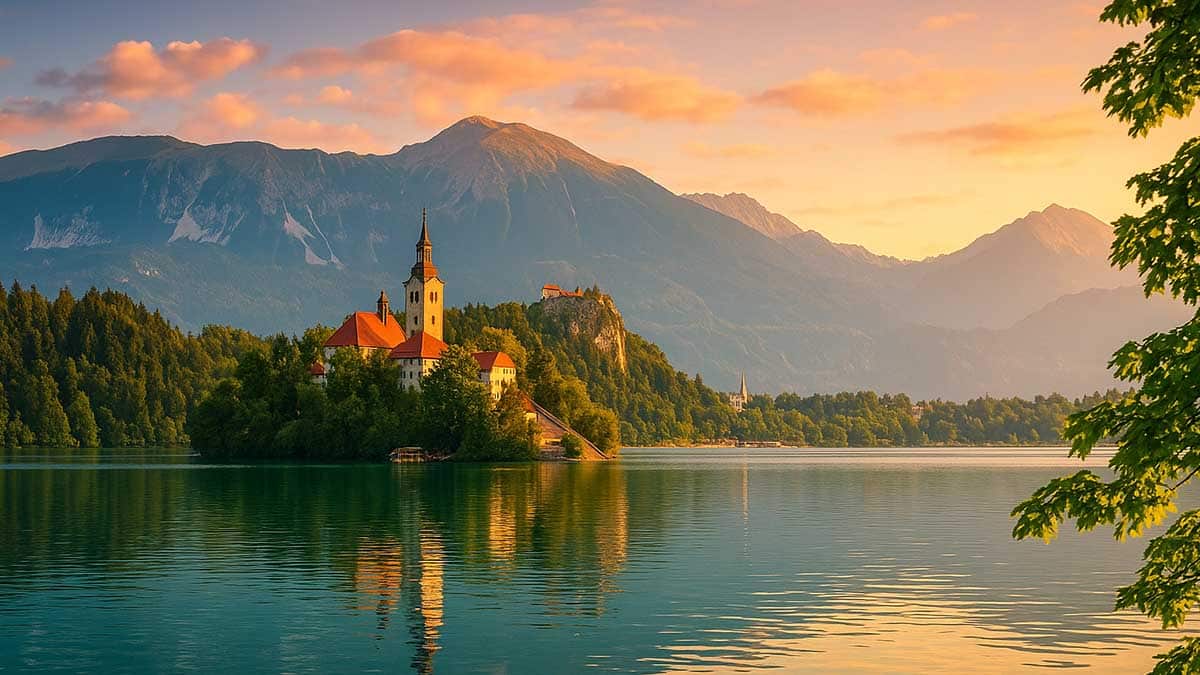
Look, Slovenia doesn’t mess around when it comes to scenery. Lake Bled sits tucked into the Julian Alps in the Upper Carniola region, stretching about 2.1 kilometers long and dropping to 30 meters at its deepest point. On windless mornings, the surface becomes this absurd mirror – every tree, every peak, every cloud gets duplicated perfectly in the water.
But what actually sets Bled apart from, say, a hundred other pretty European lakes? It’s not one thing. It’s how everything layers together in this compact, walkable area. You’ve got outdoor adventures right next to centuries-old cultural sites. Modern infrastructure that doesn’t bulldoze over local character. It feels cared for without feeling manufactured, if that makes sense.
Allein reisen als Frau: Diese 15 Regeln machen’s sofort entspannter
Europa 2026: Diese 6 Reiseideen fühlen sich endlich wieder nach Urlaub an
So what makes it worth the trip? Let’s dig in.
That tiny island everyone photographs
Right in the middle of the lake floats Slovenia’s only natural island. It’s small, tear-shaped, and topped with the Church of the Assumption – you can spot its 52-meter tower from pretty much anywhere on the shore.
Getting there? You’ll take one of the traditional pletna boats. These flat-bottomed wooden vessels get rowed (not motored) by oarsmen whose families have been doing this for generations. Some bloodlines go back to the 12th century. The boats themselves are hand-built, hand-painted. There’s a whole craft tradition here.
Once you dock, you’re staring up at 99 stone steps. At the top sits the church, and inside the tower hangs the wishing bell. Ring it, make a wish – that’s the deal. The legend? A widow cast a bell for the chapel after her husband died, but it sank in a storm during transport. The Pope heard about it, got moved by the story, and sent a replacement. That’s the bell visitors ring today.
The church itself dates from the late 1600s, though Christian worship on this spot goes back to the 9th century. Inside you’ll find baroque frescoes layered over gothic bones from different renovation periods. They still hold Mass on Sundays – it’s an active church, not just a tourist prop.
Worth knowing:
Pletna rides run €12-15 per person roundtrip. They operate year-round (reduced schedule in winter). Go early morning for glass-calm water and actual breathing room.
The castle that’s seen it all
Bled Castle doesn’t sit by the lake. It looms over it from a 130-meter cliff. Documents mention it as far back as 1011 – Slovenia’s oldest recorded castle. The original Romanesque tower’s still there. Through the Middle Ages, they added more towers, beefed up the defenses. The chapel in the upper courtyard went up in the 1500s, got a baroque makeover around 1700.
These days the castle houses a museum, working printing press, wine cellar, and a terrace café. That terrace? Unobstructed views across the entire lake, the island, the Alps stacked up behind everything. A lot of people time their visit for sunset. Smart move – the light turns everything gold.
The café serves kremšnita, which you’ll see everywhere in Bled but should definitely eat here. It’s this layered pastry situation: vanilla custard, whipped cream, flaky sheets. Local bakeries have been perfecting the ratios for decades. Does eating it while staring at this view make it taste better? Probably not. Does it feel right? Absolutely.
Budget check:
€15 gets you into the castle (adults). Combined tickets with other attractions can save a few euros. Student and senior discounts exist.
When the lake isn’t enough
Four kilometers northwest of Bled village, you’ve got Vintgar Gorge. This narrow limestone canyon runs 1.6 kilometers, with wooden walkways clinging to the rock face above the Radovna River. The path weaves past turquoise pools, over small rapids, ending at Šum Waterfall – a 13-meter drop that’s worth the walk by itself.
Budget 90 minutes if you’re not rushing. Wear real shoes, not sandals – sections get properly slippery. They close it in winter when ice makes everything sketchy, reopen in spring.
Around the lake proper, there’s a 6-kilometer perimeter path. Takes about two hours, stays mostly flat. Benches scattered along the route if you need to stop and stare at the water for a bit.
Want to move faster or harder? Take your pick:
Cycling – Flat lakeside loops or steep mountain trails if you’re feeling ambitious.
Water stuff – SUP, rowing, swimming once the water warms up in summer months.
Canyoning – Guided trips through nearby gorges. Rappelling, swimming, the works.
Winter – Cross-country skiing, ice skating when the lake freezes (doesn’t happen every year, but when it does, locals walk out to the island).
So why did it win?
Time Out’s ranking looked at the obvious stuff – natural beauty, yeah – but also how easy places are to actually reach, cultural depth, overall visitor experience. Bled scored high across all of it. That’s what edged out the usual suspects.
Slovenia’s tourism approach helps. They’ve put real limits on commercial development around the shoreline. Most accommodations? Small, family-run. Not a Hilton in sight. It keeps the character intact while still providing what travelers need.
The country’s compact size works in your favor too. All of Slovenia fits into 20,000 square kilometers. Ljubljana airport sits 35 kilometers away (40-minute drive). The capital itself? 55 kilometers south. You can do city and nature in one trip without heroic logistics.
Translation:
Bled delivers quality without requiring you to become a planning ninja. Infrastructure exists, English is widely spoken, buses connect the dots, safety standards are European-level solid.
When to go (and when to maybe not)
Summer (June-August)
Warmest water, best swimming conditions. Also peak season – more people, higher prices, occasional traffic jams. If you go, book ahead.
Spring/Fall (April-May, September-October)
Temperature sweet spot. Fewer tourists. Spring brings wildflowers and snowmelt waterfalls. Fall brings those autumn colors everyone posts on Instagram. Often the best overall window.
Winter (December-February)
Cold, obviously. Snow-covered Alps look dramatic. Some activities shut down. Crowds vanish. Different vibe entirely – peaceful, stark, beautiful in its own way.
Getting around, eating, staying
Most people base in Bled village. Accommodation spans the full range – hostels to luxury hotels – all within a walkable area.
Buses run to Ljubljana and regional spots multiple times daily. Renting a car unlocks flexibility for places like Lake Bohinj or Triglav National Park, but isn’t strictly necessary.
Food-wise, Slovenia blends Central European heartiness with Mediterranean freshness. Beyond the kremšnita, try žlikrofi (dumplings – they’re good), štruklji (rolled pastries), and anything involving local honey. Beekeeping’s a major tradition here.
Hit the local markets for produce and regional stuff. Small family restaurants around the lake serve proper home-cooked meals with seasonal ingredients. Prices stay sane compared to, say, Switzerland or Norway.
But is it actually Europe’s most beautiful place?
Depends who you ask, right? Beauty’s subjective. Santorini’s white cliffs against blue domes? Norway’s fjords cutting between mountains? Scotland’s brooding highlands? All stunning, all different.
What Bled offers is density. Everything’s concentrated – natural grandeur, cultural substance, accessible adventure, logistics that just work. You don’t need two weeks and a car to scratch the surface.
Different travelers get different things out of it. Photographers find compositions everywhere. Outdoor people access varied terrain without driving hours between activities. Culture types discover traditions that haven’t been sanitized for tourists. If you just want somewhere peaceful to decompress, the lakeside delivers that too.
Dresden in 2 tagen: Altstadt, Elbe und Neustadt ohne Stress erleben
Bodensee auf deutscher Seite: Konstanz, Mainau und Lindau entspannt entdecken
The Time Out recognition acknowledges something real – Bled’s managed to maintain quality while welcoming growing visitor numbers. Mass tourism hasn’t wrecked it. The water’s still clear, the castle still commands its cliff, the mountains keep their watch.
Whether it tops your personal list depends on what you value in a destination. But understanding why it topped this particular ranking might just convince you to go see for yourself.